Minhub

Cadoux Limited owns a 50% interest in Minhub Operations Pty Ltd (MOPL), the developer of a proposed mineral processing facility in Darwin focused on the extraction and processing of rare earths and other critical minerals.

The Minhub mineral separation plant (MSP), known as “The Minhub Project” or “Minhub”, is being developed with the intention of strengthening secure and diversified supply chains for critical minerals while supporting Australia’s emergence as a leading participant in the global energy transition and advanced manufacturing sectors.


The Minhub Project

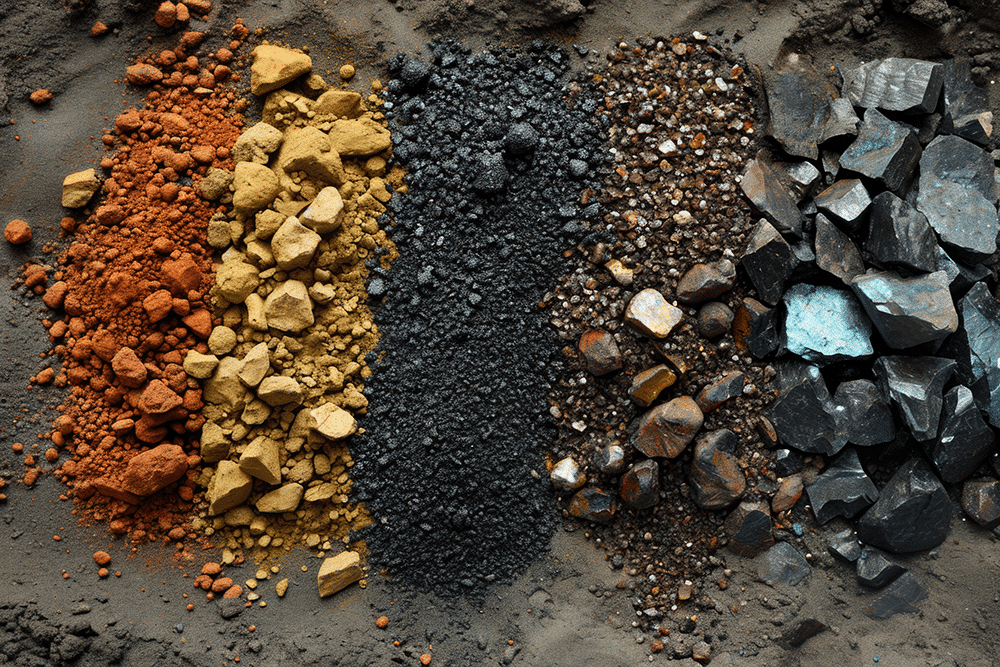
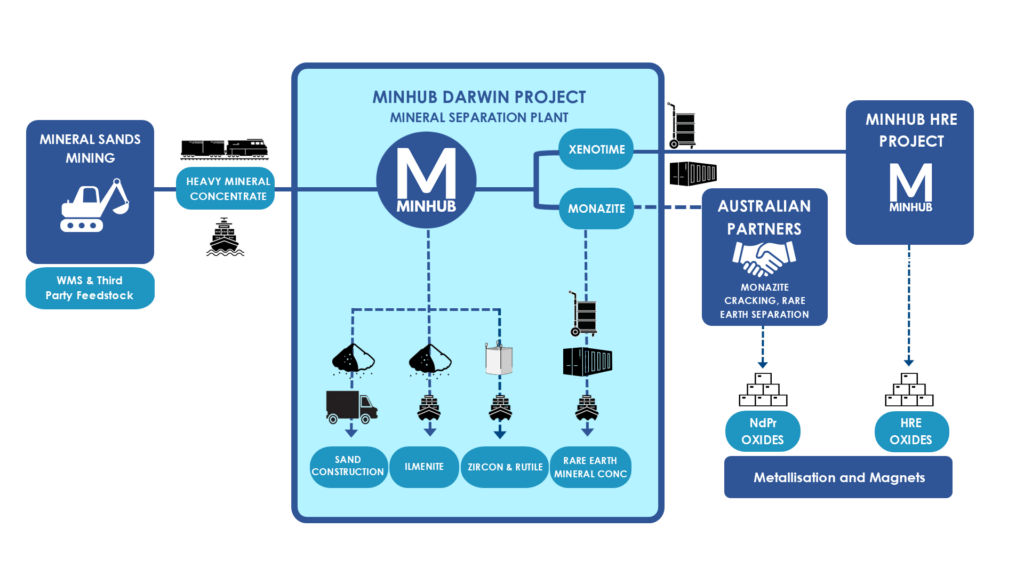
The Minhub Project is a mineral separation facility and associated infrastructure where the valuable rare earth minerals monazite and xenotime along with zircon and titanium minerals rutile and ilmenite are separated from mineral sands concentrates (‘feedstocks’) sourced from a new generation of rare earths rich Australian mineral sands projects

As Australia’s first ‘multi-user’ collaborate processing facility Minhub will work with feedstock and downstream partners to deliver a premium ethical, sustainable, traceable, reliable supply of rare earth and other critical minerals into Australia’s sovereign supply chains.

Australia is a global powerhouse of mineral sands mining with the world’s largest resources of rutile and zircon (Australian Critical Minerals Prospectus, 2022). Australia produces over 25% of global production of those minerals, and close to 10% of global ilmenite. Together with those finished products, Australia produces a significant amount of raw (heavy mineral concentrate ‘HMC’) and intermediate mineral concentrates containing valuable economic minerals, such as zircon, ilmenite, rutile, and along with globally significant quantities of high grade valuable rare earths minerals monazite & xenotime.

Over the last 20 years, Australian mineral sands projects have increasingly shipped these raw and intermediate products to Asia where a large downstream mineral processing industry has developed. In China, numerous small and medium sized processors combined with large State supported companies and well-developed policies that encourage the import of concentrate has enabled China to become the dominant global player in zircon processing and titanium pigment manufacture, while also capturing valuable rare earth feedstocks which have helped to consolidate China’s position in that sector.

Today a new generation of Australian mineral sands deposits are being developed, particularly in the rare earth rich Murray and Gippsland Basins of southeastern Australia. The Minhub Project aims to deliver an independent mineral processing hub, strategically located in Darwin a which can act as a collaborative processing option for mineral sands developers and facilitating a sovereign supply chain for critical rare earths.

The Project has been designed working closely with Minhub’s industry leading technology partner IHC-Mining incorporating process design that will enable the processing of HMC and intermediate products from several emerging rare earth rich mineral sands projects. The MSP will utilise conventional industry standard physical separation equipment such as gravity separation (wet tables, spirals and classifiers), along with dry mineral separation equipment such as rare earth magnets and electrostatic separators. Finished products from the Project will include rare earth minerals monazite and xenotime as well as zircon and titanium products such as rutile and ilmenite.

Why Darwin?

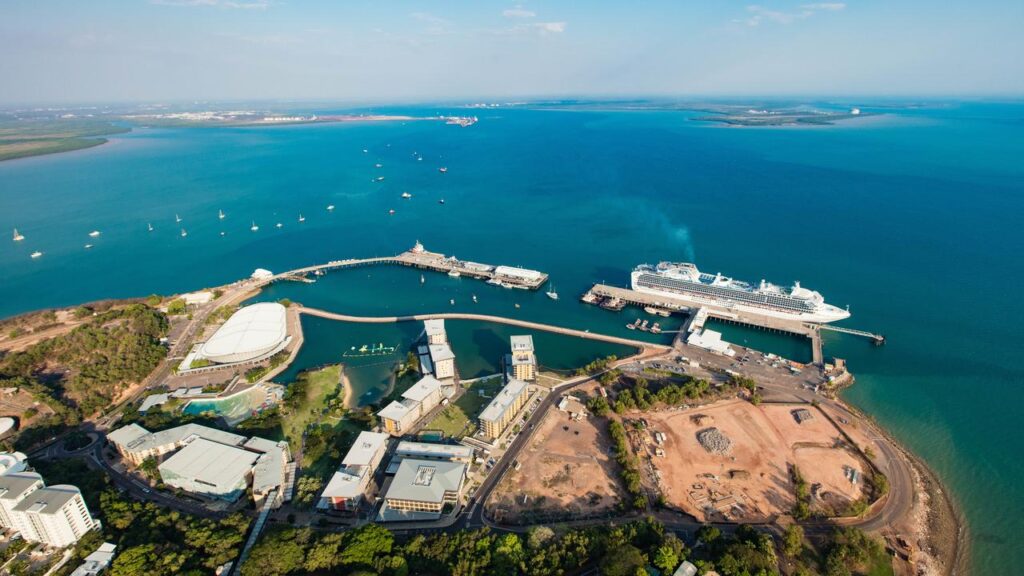
​Darwin is the natural site for a mineral processing hub, where high value mineral concentrate from Australia’s southern ports can be processed, offering access to international markets.

  • Darwin is an underutilised, deepwater port on the North Australian Coast, connected to substantial rail infrastructure with a significant time saving over shipping from southern ports 
  • Direct rail access for mineral sands concentrates from southern mineral sands mines
  • Strategically located near major global markets and shipping lanes
  • Strong Commonwealth and Territory support to see the NT established as a premier critical minerals processing centre

What are Rare Earths?

Rare earth elements (REEs) are a group of 17 critical minerals underpinning modern technology, from renewable energy and electric vehicles to advanced electronics.

Their unique magnetic, luminescent, catalytic, and conductive properties make them indispensable across high-value industries including electronics, ceramics, glass, lighting, and metallurgy.

As global electrification accelerates, rare earth demand is surging—driven by permanent magnets used in wind turbines and EV motors. The key “magnet feed” elements are Neodymium and Praseodymium (NdPr), essential for NdFeB magnets, and Dysprosium and Terbium (DyTb), which enable high-performance operation in extreme temperatures such as EV drivetrains.

Demand growth is accelerating fast. Project Blue forecasts NdPr oxide demand to rise 136% over the next decade, while demand for heavy rare earths outside China is set to outstrip non-Chinese supply by nine times.

The result: increasing Western dependence on China and intensifying pressure on already constrained global supply chains.making the western world increasingly dependent upon Chinese production sources and putting Chinese domestic supply under pressure.

Monazite is a cerium phosphate mineral that commonly occurs in mineral sands deposits and is a vital source of light rare earths neodymium and praseodymium.

Monazite is significantly concentrated in the Gippsland and Murray Basins in SE Australia but has also been produced historically as a valuable by-product on the West Coast of Australia.

Xenotime is a rare and very valuable mineral, rich in heavy rare earths and the most critically sought magnet feed metals dysprosium and terbium.

Xenotime is uniquely concentrated in the Murray Basin and particularly Victoria’s Gippsland Basin. Xenotime represents an important environmentally sustainable alternative to heavy rare earths to the ionic clay deposits mined in China and Myanmar.

Titanium-bearing minerals such as Ilmenite, Rutile, and leucoxene are sourced from mineral sands deposits. Over 90% of global supply of titanium minerals are used in the production of titanium pigment for paints, coatings, plastics, and cosmetics due to its bright-white colour, opacity, and UV-resistant properties. Titanium metal is prized for being incredibly light yet strong and corrosion resistant and is used extensively in industrial applications.

Zircon is highly valued for its durability, high refractive index, and heat and abrasion resistance.When finely milled, it is used primarily in ceramics as a highly resistant opacifier.

As a sand material it is used in foundry or refractory applications but is also frequently processed into zirconium-based chemicals or zirconium metal.


Stylised Diagram of Minhub’s Business Model